Breaking into investment banking requires understanding that there isn't one universal path, your strategy depends entirely on where you're starting from and how much time you have. Whether you're a freshman at a target school, a senior at a non-target desperately networking, or a Big 4 analyst looking to lateral, each pathway demands different tactics and timelines.
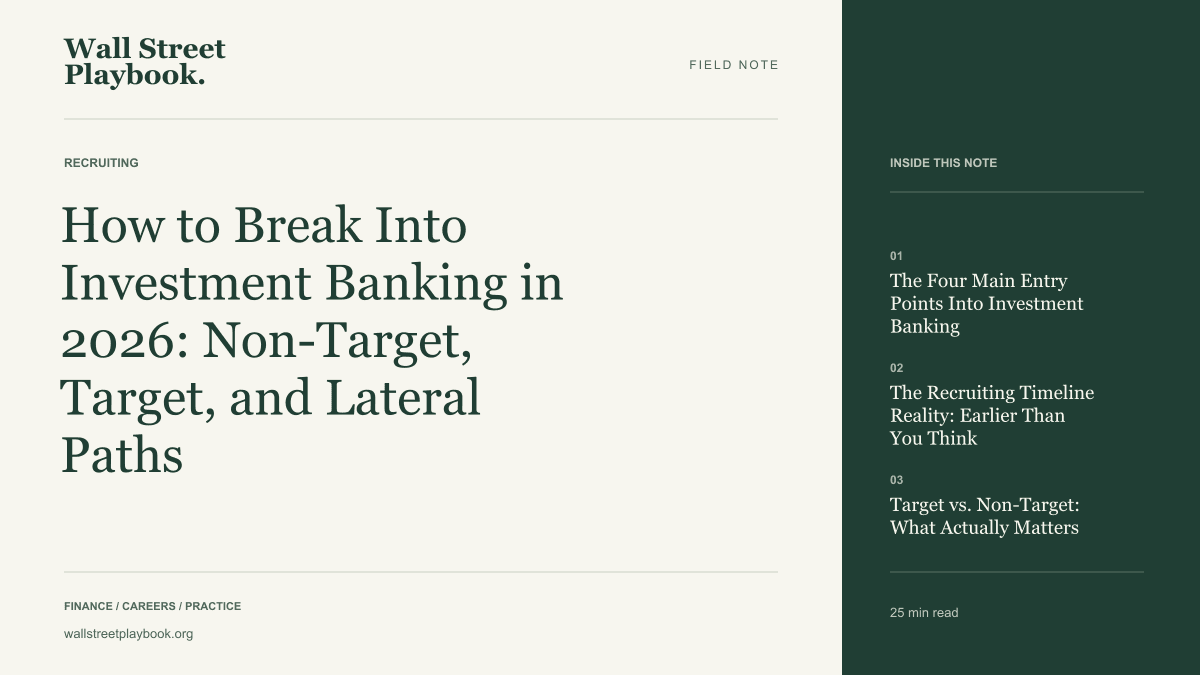
The Four Main Entry Points Into Investment Banking
Investment banking recruiting operates around four distinct pathways, each with its own timeline, difficulty level, and prerequisites.
Undergraduate at a Target or Semi-Target School remains the cheapest and most straightforward path. If you attend schools like Wharton, Harvard, NYU Stern, Michigan Ross, or Berkeley Haas, you'll have access to structured on-campus recruiting where bulge bracket banks actively come to you.
Recent Graduates face a compressed window and must act with urgency. The critical rule: your chances decrease dramatically if you wait more than 1-2 years after graduation.
MBA Candidates follow a highly structured timeline that starts the moment you confirm your MBA acceptance. Recruiting technically begins before you even start classes.
Lateral Hires with 1-3 years of full-time investment banking or closely related experience can move between banks or from adjacent fields like Transaction Advisory Services.
The Recruiting Timeline Reality: Earlier Than You Think
Investment banking recruiting has accelerated to absurd levels. For junior year summer analyst positions, applications now go live 12-18 months before the internship starts. Bulge bracket banks begin posting applications as early as January-February of sophomore year.
The majority of summer analyst offers get extended between January and April of sophomore year, meaning recruiting wraps up a full 15 months before you'd start the internship.
Target vs. Non-Target: What Actually Matters
The target school advantage is real but not insurmountable. Banks pay career centers for exclusive access because it's financially efficient.
Target schools (Wharton, Harvard, Princeton, Stanford, MIT, Columbia, Duke, NYU Stern, Michigan Ross) get on-campus recruiting visits and automatic resume reviews. Students generally can get interviews with a GPA above 3.5, though top banks prefer 3.7-3.8+.
Non-target schools require a completely different strategy:
- Maintain a GPA of 3.7+ as a bare minimum (ideally 3.8-3.9)
- Network 3-4x as much as target school peers
- List your SAT/ACT scores on your resume if strong (1500+ SAT, 34+ ACT)
- Target middle-market banks and regional boutiques first
Get the 10 resume bullets PDF
Use the free before-and-after bullet examples before you apply or start networking.
No spam. Unsubscribe anytime.
Building Your Pre-Internship Foundation
You will not break into a bulge bracket internship with a blank resume. Banks expect to see relevant "steppingstone" experience.
Freshman and early sophomore summers should focus on getting any finance-adjacent experience: corporate finance, wealth management, corporate banking, Big 4 accounting firms, or financial analyst roles at startups.
Academic preparation needs to happen concurrently. You must learn accounting fundamentals, financial statement analysis, and valuation methodologies before interviews begin.
Networking: The Non-Negotiable Differentiator
Networking isn't optional, it's the primary determinant of whether you get interviews, especially from non-target schools.
Volume requirements: From a target school, you need 20-30 networking calls to get a meaningful advantage. From a non-target, plan for 50-100+ outreach emails and 30-50 completed calls.
The cold email framework that works has three components:
- Establish your point of connection
- Make a specific ask focused on advice, not jobs
- Propose three specific times you're available
Keep emails to 5 sentences maximum and always use your school email address.
Recommended Resource
How to Break Into Finance - 2026
84 pages. The recruiting system from first target list to signed offer.
The Interview Process
Behavioral/fit questions assess whether you'll survive the hours and have genuine interest. Core questions: "Walk me through your resume," "Why investment banking?", "Why our bank?"
Technical questions test accounting, valuation, and deal mechanics. Core topics include: three-statement linkages, DCF analysis, LBO modeling, and M&A accretion/dilution.
The Superday is the final stage where you meet 3-6 bankers in back-to-back sessions. The acceptance rate averages 30-40%.
The Path Forward: What to Do Right Now
Freshmen and sophomores: Join finance clubs, secure a relevant internship, start learning accounting basics, and begin networking 6-9 months before applications open.
Current juniors: Focus on off-cycle internships and middle-market banks. Begin intensive technical preparation and complete 30-50 networking calls.
Recent graduates: Target Transaction Advisory Services or valuation roles at Big 4 firms, corporate banking, or middle-market IB roles. Land a steppingstone role within 6 months, lateral to banking within 12-18 months.
Ready to nail the technical questions? Our Finance Technical Interview Guide covers the 400+ questions you'll actually face.
Need help with your resume? Get a professional resume review from finance professionals who've screened thousands of candidates.