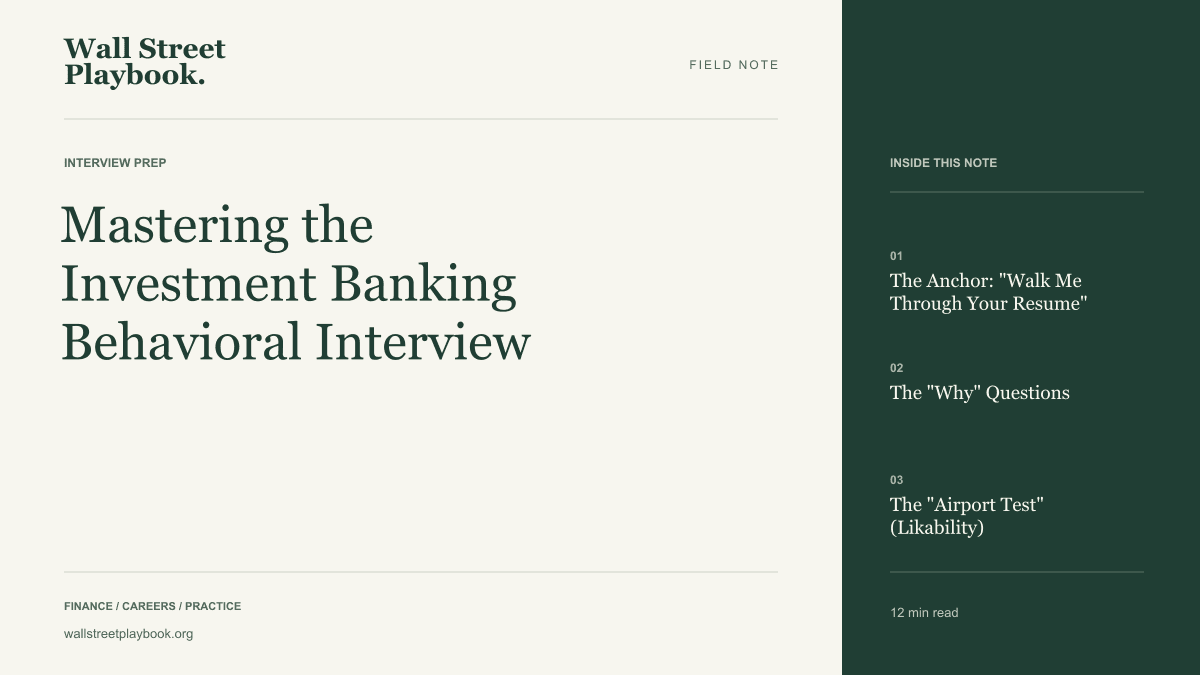
You can have a 4.0 GPA from Wharton and know how to build an LBO model in your sleep, but if you fail the "Airport Test," you will not get an offer.
Investment banking interviews are split 50/50 between technicals and behaviorals. Technicals are binary, you're either right or wrong. Behaviorals are subjective. They answer the only question that matters to a VP at 2 AM: "Can I stand to be around this person for 100 hours a week?"
The Anchor: "Walk Me Through Your Resume"
This is the first question in 99% of interviews. You have exactly 2-3 minutes to set the narrative arc of your life.
The 4-Step Structure (The "Spark" Method):
1. The Spark (The Beginning): Start with where you're from and the initial trigger for your interest.
"I grew up in Chicago and first got interested in finance when I started trading my own small portfolio in high school…"
2. The Growing Interest (College): Move to your university choice and relevant activities.
"I chose [University] because of its strong business program. I joined the Investment Banking Club freshman year…"
3. The Professional Pivot (Internships): Walk through work experience. For each role, explain what you did and why you moved.
"Last summer, I worked at [Firm]. While I enjoyed the client interaction, I realized I wanted larger, transaction-based deals, which led me to target investment banking…"
4. The "Why You're Here" (The Close): Bring it to the present.
"That experience confirmed IB is the right path. I'm specifically excited about [Bank] because of your strength in [Industry] and the conversations I've had with [Alum Name]."
Fatal Mistake: Reciting your resume line-by-line. They have your resume. They want the story.
Get 20 must-know interview questions
Use the free question pack to turn interview concepts into short, repeatable answers before you practice live.
No spam. Unsubscribe anytime.
The "Why" Questions
"Why Investment Banking?"
Bad: "I want to make money and exit to PE." (Too mercenary) Bad: "I love finance and modeling." (You can do that in accounting)
Good (The "High-Stakes" Angle):
"I want to work in investment banking because I thrive in high-pressure environments where my work has tangible impact. In my last internship, I loved the intensity of [Project], but I wanted to be closer to transaction execution. Banking offers the fastest way to build that skillset on live deals."
"Why Our Firm?"
Bad: "You're a top-tier bulge bracket with great culture." (Applies to everyone)
Good (The "People + Deal" Combo):
"Two reasons. First, I've been following your work on [Specific Deal], I found the structure really interesting. Second, the people. I've spoken with [Alum] and [Analyst], and they both emphasized how senior bankers here invest in junior development."
The "Airport Test" (Likability)
The "Airport Test": If I were stuck at O'Hare with this candidate for 4 hours during a flight delay, would I want to kill myself?
How to Pass:
- Have Hobbies: If asked "What do you do for fun?", don't say "Read the Wall Street Journal." Say "I'm training for a marathon" or "I'm trying to cook every recipe in this cookbook."
- Smile and Banter: If they ask "How are you?", don't just say "Good." Say "Doing well, though I'm ready for this Chicago winter to be over. How's your week going?"
- Read the Room: Mirror their energy. If serious, be professional. If laid back, loosen up slightly.
Recommended Resource
Behavioral Interview Guide
41 pages. 50 real questions, the CARL+ framework, and firm-specific answer patterns.
Structured "War Stories" (The STAR Method)
Prepare 5 "Core Stories" that adapt to any behavioral question. Use STAR:
- Situation (10%): Set the scene. "During my internship at X…"
- Task (10%): What was the problem?
- Action (70%): What did YOU specifically do?
- Result (10%): The outcome.
The "Greatest Weakness" Trap:
Don't say: "I work too hard" (Humble-brag, they hate this) Don't say: "I'm bad at math" (Disqualifying)
Do say: A real weakness you're actively fixing.
"I sometimes struggle with delegating because I want everything perfect. In my last project, I realized this created bottlenecks, so I created a shared tracker to assign tasks. It's something I'm still improving."
The Final 5 Minutes: Asking Good Questions
Saying "No" to "Do you have any questions?" is an automatic fail.
Ask specific questions that show you were listening:
- "You mentioned you worked on [Deal X], how did the team handle the regulatory challenges?"
- "What's the one skill that separates a top-bucket analyst from an average one in this group?"
Want 30+ example stories and frameworks for every behavioral question? Get the Behavioral Interview Guide.
Ready to nail the technicals too? Check out the Finance Technical Interview Guide.