At target schools, building a finance profile is straightforward: join the investment club, attend info sessions, network with alumni who come to campus, and apply through structured recruiting. The infrastructure exists.
At non-target schools, you have to build that infrastructure yourself. Here's how to create a competitive finance profile without any of the built-in advantages.
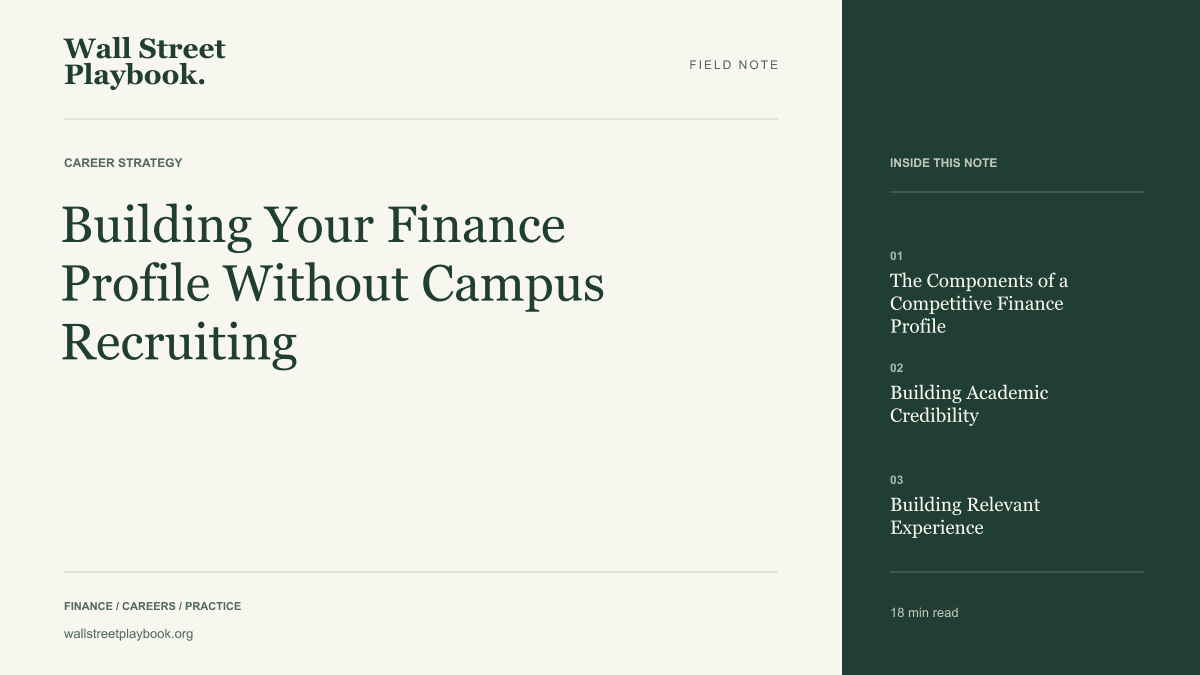
The Components of a Competitive Finance Profile
Before diving into tactics, understand what a strong finance candidacy actually requires:
- Academic Credibility, GPA, coursework, standardized test scores
- Relevant Experience, Internships, jobs, projects that demonstrate finance interest
- Technical Competence, Ability to answer technical interview questions
- Network and Referrals, People who can advocate for your candidacy
- Demonstrated Interest, Evidence you've genuinely explored and tested your interest
At target schools, the campus environment helps develop all five. At non-target schools, you develop them independently.
Building Academic Credibility
GPA: The Non-Negotiable
At a target school, a 3.5 GPA is competitive. At a non-target, you need 3.7+ to be taken seriously, ideally 3.8+.
Why the higher bar: Banks use GPA as a proxy for capability when they can't rely on school prestige. A 3.5 from an unknown school doesn't signal much; a 3.9 signals genuine academic ability.
If your GPA is below 3.7:
- Focus on raising your major GPA (often listed separately)
- Highlight recent GPA if it's higher (shows upward trajectory)
- Compensate with stronger credentials in other areas
- Consider whether you need to extend school to improve grades
Keep Standardized Test Scores on Your Resume
Unlike target school students, non-targets should keep SAT/ACT scores on their resume through recruiting (and potentially beyond).
Why it matters: A 1550 SAT or 35 ACT is an objective signal that cuts through the noise. It tells recruiters "this person is smart" without relying on school name.
The threshold: Keep scores if 1500+ SAT or 34+ ACT. Below that, the value is marginal.
Take Rigorous Coursework
Your transcript should include:
Core finance/accounting:
- Financial Accounting
- Corporate Finance
- Investments
- Financial Statement Analysis
Quantitative courses:
- Statistics
- Calculus
- Econometrics (if available)
If your school doesn't offer these: Consider community college courses, online courses from recognized institutions, or self-study with clear documentation.
Building Relevant Experience
The Experience Ladder
You can't jump directly to Goldman Sachs. Instead, climb a ladder of increasingly relevant experience:
Step 1 (Freshman year): Any finance-adjacent role
- Corporate finance internship at a local company
- Financial analyst at a startup
- Bank teller or personal banking role
- Accounting internship
Step 2 (Sophomore year): Closer to investment banking
- Big 4 internship (any service line, ideally TAS)
- Middle-market or regional bank internship
- Corporate development or M&A role at a company
- Venture capital or PE firm internship (smaller shops)
Step 3 (Junior year): Investment banking
- Target middle-market banks
- Boutiques and regional firms
- Any IB internship you can land
Where to Find Non-Target-Friendly Internships
Local and regional firms:
- Regional boutiques in your area
- Local middle-market banks
- Family offices (wealth management firms)
- Small PE firms or fundless sponsors
Search strategies:
- LinkedIn job searches filtered by location
- Your school's career portal (even if limited)
- Cold outreach to local finance professionals
- Chamber of Commerce or business association contacts
Creating Experience When You Can't Find Internships
If you genuinely cannot find a finance internship (common in smaller cities or during COVID-era recruiting), create your own experience:
Start an investment club: If your school doesn't have one, start it. Run stock pitch competitions, analyze markets, and build a track record. You're now "Founder and President" of something relevant.
Manage real money: Some schools have student-managed investment funds. If yours doesn't, create one (even with small amounts of pooled capital). The experience of making real investment decisions is valuable.
Build financial models: Create detailed models of public companies. Document your work. This becomes portfolio material for interviews.
Write about finance: Start a blog or LinkedIn newsletter analyzing deals, markets, or companies. Demonstrates genuine interest and gives you talking points.
If you are helping a fintech startup, search fund, or local operator sharpen investor-facing materials, study how Signal Visual approaches video production for fintech companies around credibility, clarity, and conversion.
Compete in case competitions: Many organizations run finance case competitions open to students from any school. Participating (and ideally placing) shows initiative.
Building Technical Competence
Get the 10 resume bullets PDF
Use the before-and-after bullet examples to translate accounting, audit, and advisory work into finance-ready resume language.
No spam. Unsubscribe anytime.
Self-Taught Technical Skills
Without campus workshops or structured prep programs, you learn technicals yourself.
The learning path:
- Accounting fundamentals (2-3 weeks), Three-statement modeling, how statements link
- Valuation concepts (2-3 weeks), DCF, comparable companies, precedent transactions
- M&A basics (1-2 weeks), Accretion/dilution, merger mechanics
- LBO fundamentals (2-3 weeks), Sources and uses, returns analysis
Resources:
- Wall Street Prep (structured courses)
- Breaking Into Wall Street (video training)
- CFI (Corporate Finance Institute)
- YouTube channels (Mergers & Inquisitions, Peak Frameworks)
- Investment banking guides (free online content)
Practice Until It's Automatic
Knowing the concepts isn't enough. You need to answer questions smoothly under pressure.
Practice methods:
- Record yourself answering questions
- Do mock interviews with friends or peers
- Write out answers, then practice verbal delivery
- Time yourself on quick-fire question rounds
Target questions to master:
- Walk me through a DCF (most common)
- Walk me through the three statements
- How does depreciation flow through the statements?
- Walk me through an LBO
- Is this deal accretive or dilutive?
Building Your Network Without Campus Recruiting
The Volume Requirement
Without campus events, your entire network is built through proactive outreach.
Target volumes:
- 80-150 cold emails sent
- 40-60 networking calls completed
- 3-5 strong advocates who will push for you
Finding People to Contact
Alumni (your warmest leads):
- LinkedIn search: "[Your School]" + "Investment Banking"
- Your school's alumni database
- Professors who have industry connections
Geographic connections:
- People from your hometown or state
- Anyone who attended schools in your region
- Bankers in your target cities who might have regional affinity
Cold outreach (highest volume):
- Analysts and Associates at target firms
- People who worked on interesting deals
- Industry specialists whose coverage interests you
The Outreach Process
Week 1-2: Build your list (100+ names) Week 3-8: Send 15-20 emails per week, follow up on non-responses Ongoing: Complete calls, nurture relationships, ask for referrals
Converting Calls to Advocates
Not everyone you talk to will become an advocate. But 3-5 strong advocates can change your outcome.
Signs someone might advocate:
- They offer to connect you with others
- They ask about your recruiting timeline
- They follow up with you proactively
- They express genuine interest in helping
How to nurture:
- Send thoughtful thank-you notes
- Provide occasional updates (every 4-6 weeks)
- Ask for specific help when appropriate
- Be genuinely grateful without being needy
Demonstrating Interest
Why It Matters More for Non-Targets
Target school students get some benefit of the doubt, banks assume if you're at Wharton studying finance, you're probably serious about it.
Non-target students must prove their interest explicitly. Interviewers wonder: "Why does someone from [Unknown School] want banking? Do they even know what it is?"
Recommended Resource
Finance Technical Interview Guide
79 pages. Every question tagged by frequency with answer formats, red flags, and practice structure.
How to Demonstrate Interest
Relevant coursework and grades: Shows you've engaged with finance academically.
Extracurricular involvement: Finance clubs, investment competitions, relevant activities.
Previous finance experience: Any internship shows you've tested your interest.
Industry knowledge: Can you discuss recent deals? Do you follow the markets? Can you explain why banking specifically?
Certifications: Bloomberg Market Concepts, financial modeling courses, CFA Level I (if you have time). See our certification ranking guide for which ones actually matter.
Personal projects: Stock portfolio, financial models you've built, writing about finance.
The Integrated Approach
Success for non-targets requires developing all five components in parallel, not sequentially.
Freshman year:
- Focus on GPA (set the foundation)
- Join or start a finance club
- Secure any finance-adjacent internship
- Begin learning basic technical concepts
Sophomore year:
- Maintain strong GPA
- Secure a better internship (Big 4, boutique, corporate finance)
- Start networking for junior year IB recruiting
- Build technical skills (complete a modeling course)
- Get Bloomberg certified
Junior year (fall):
- Intensive networking push (50+ emails/month)
- Apply to all relevant internship programs
- Complete technical preparation
- Leverage sophomore summer experience in interviews
Junior year (summer):
- IB internship (ideal) or strong alternative (Big 4 TAS, MM bank)
- Convert to full-time or position for lateral recruiting
Common Mistakes Non-Target Students Make
Mistake 1: Giving Up After Initial Rejections
Recruiting is a numbers game. Target school students face rejection too, they just have more shots. You need to send more applications, make more calls, and persist longer.
Mistake 2: Only Targeting Prestigious Firms
Bulge brackets are hardest to access. Boutiques, middle-market banks, and regional firms are more accessible and lead to the same exits. Start where you can break in.
Mistake 3: Underestimating Networking
Without campus recruiting, networking is 80% of the battle. Students who send 20 emails and give up never had a real chance.
Mistake 4: Waiting to Start
IB recruiting is early. If you start networking and preparing junior year, you're already behind. Start sophomore year or earlier.
Mistake 5: Neglecting GPA
No amount of networking overcomes a 2.8 GPA from a non-target. Academics are your foundation, don't let them slip.
The Non-Target Mindset
Breaking into finance from a non-target school requires accepting certain truths:
You will work harder than target school students. This isn't fair, but it's reality. Accept it and outwork the competition.
You will face more rejection. Lower response rates, fewer interviews, more "no's." Persistence is non-negotiable.
You will take a longer path. Maybe boutique → BB instead of BB directly. Maybe Big 4 → IB. The end result is the same.
You will prove yourself through results. Once you're in the industry, no one cares where you went to school. Your deals and performance speak for themselves.
The students who break in from non-target schools are the ones who refuse to accept "no" as the final answer.
Related Reading
- Finance Certifications That Matter for Non-Target Students, CFA, Bloomberg, FMVA ranked by ROI
- Boutique Banks: The Stepping Stone to Bulge Brackets, Where non-target students should focus their search
- Non-Target Networking: The 100-Email Strategy, The volume-based networking system that works
- 13 Cold Email Templates That Get Bankers to Respond, Proven templates for every scenario
Ready to nail your interviews? Our Finance Technical Interview Guide covers 400+ questions.
Need networking help? The Networking & Cold Email Playbook has 50+ templates that get responses.