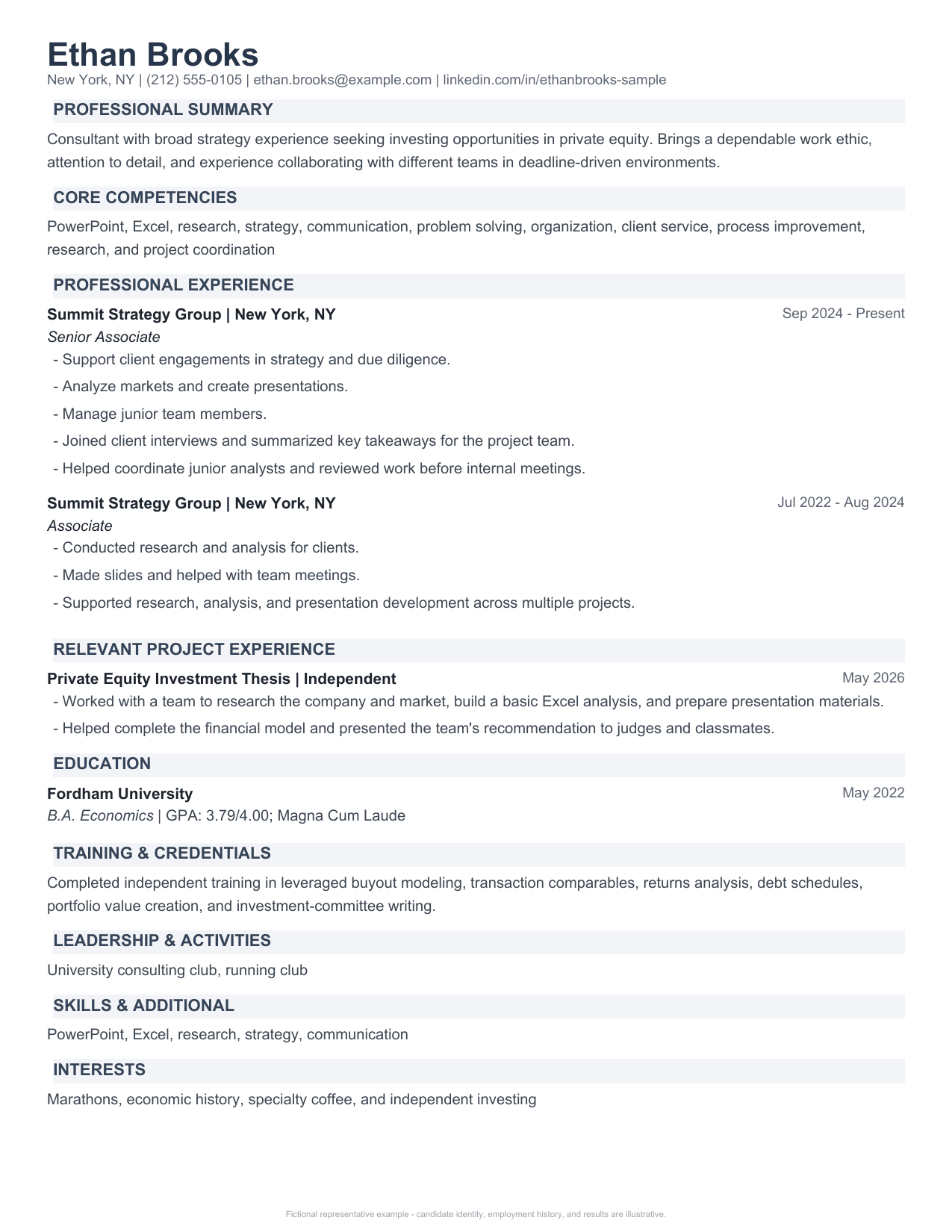
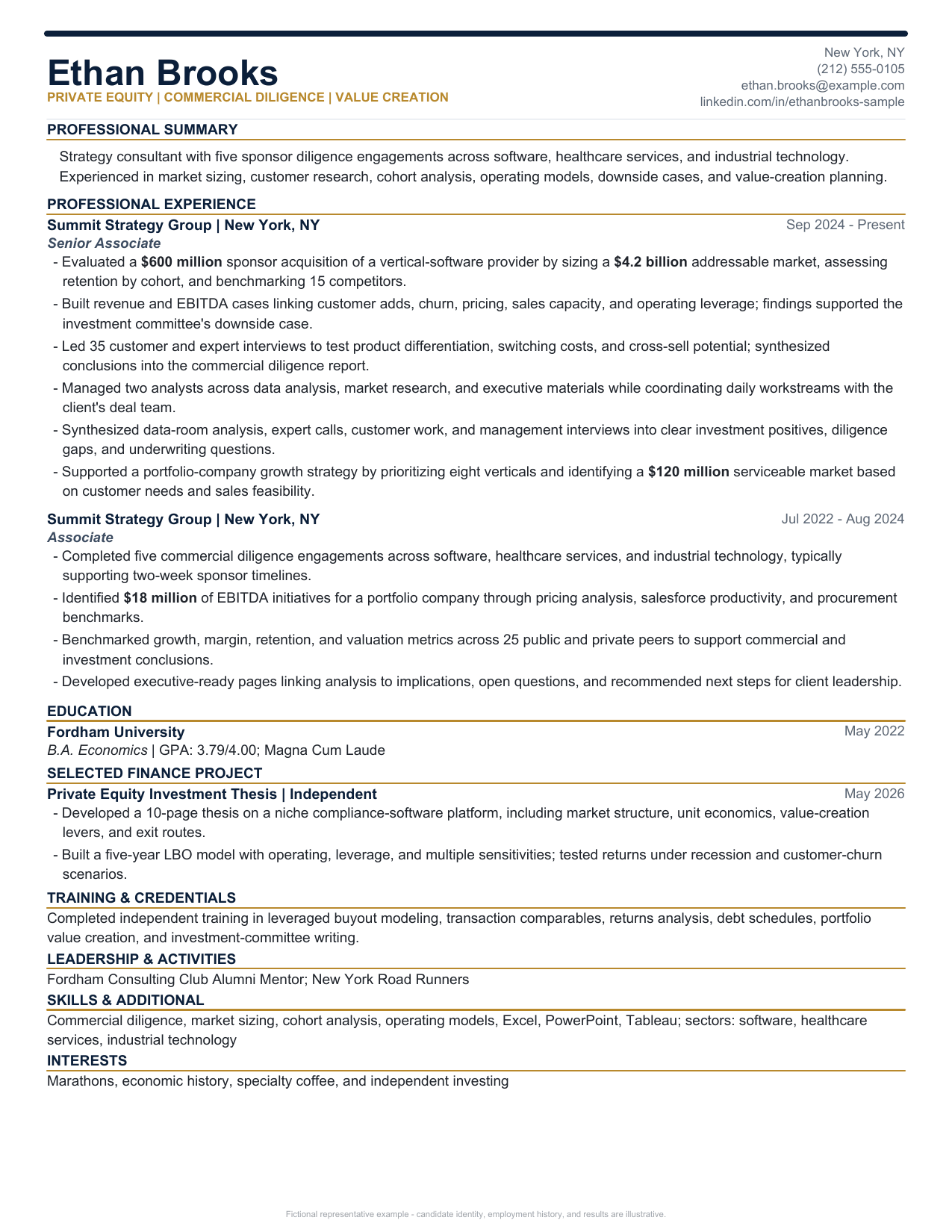
Deal participation and investment judgment are different evidence. A useful PE resume explains both your contribution and the question your analysis addressed, without implying you had authority you did not hold.
Private equity resume example: a one-page outline
Use this as a fictional structure to adapt, not a template for inventing deal experience:
- Education: degree, dates and relevant coursework, with qualifications stated accurately.
- Experience: role, employer and dates, followed by the analysis you personally performed and its purpose.
- Selected deal or project: business context, investment question, your contribution, and the true status of the process.
- Skills: modeling, research and technical tools you can demonstrate in a follow-up.
Fictional analyst bullet: “Built a downside cash-flow sensitivity for an acquisition case and summarized how customer-retention assumptions changed debt-service coverage.” A classroom case belongs in projects; an unfinished live deal must not be described as a completed investment. Follow the employer’s application instructions for required information and format.
Before asking for a review, check whether a reader can distinguish your work from the team’s work, a forecast from a realized result, and analysis from a decision you did not own. Use the free finance resume bullet exercise and investment-banking resume audit for supporting practice.
Build an investment-evidence card
For one permitted deal or public-data project, complete this card:
- Business: What generated earnings and cash?
- Question: What could make the investment fail?
- Analysis: What did you personally model or investigate?
- Finding: What changed when you tested the assumption?
- Status and ownership: What happened, and who made the decision?
Fictional example: “Compared base and downside customer-retention assumptions in an acquisition model, identifying the earnings level required to meet the case’s return hurdle.” If it was a classroom case, label it as a project. If it was a live process that stopped, do not label it a completed investment.
Replace the weak inference
| Resume claim | Follow-up it invites | Better boundary |
|---|
| Drove a successful acquisition | What decision did you own? | State your analysis and the actual transaction status |
| Generated a 25% IRR | Was this realized or modeled? | Label projected returns and the assumptions |
| Led diligence | Who assigned and reviewed the work? | Distinguish workstream ownership from support |
A modeled return is not realized performance. Use the case-sensitivity exercise to practice the reasoning behind a projected result, and the cancelled-transaction guide for accurate status wording.
Decide what needs editing
If the investment card is clear but the resume is generic, a review can identify where the evidence disappears. If your deal history overwhelms the page and the target role is unclear, a rewrite may help restructure it. If you cannot explain the analysis, prioritize practice before spending on wording.
Harvard’s resume resource provides general presentation guidance. Apply the confidential-client check before sharing details, then inspect resume service scope and examples. No example here represents an actual client placement or a promise of access to a fund.
Choose support only for the gap you found
Useful for: Candidates who need to explain their contribution and reasoning on permitted transactions.
Limit: A rewrite cannot convert participation into investment authority or create a completed deal.
A standard review gives written feedback for you to implement; a rewrite rebuilds one resume for one target role family. Standard review: $199. Standard rewrite: $499. Transaction-heavy or substantial transition work may require advanced scope; compare the included work before choosing.
Compare review and rewrite →