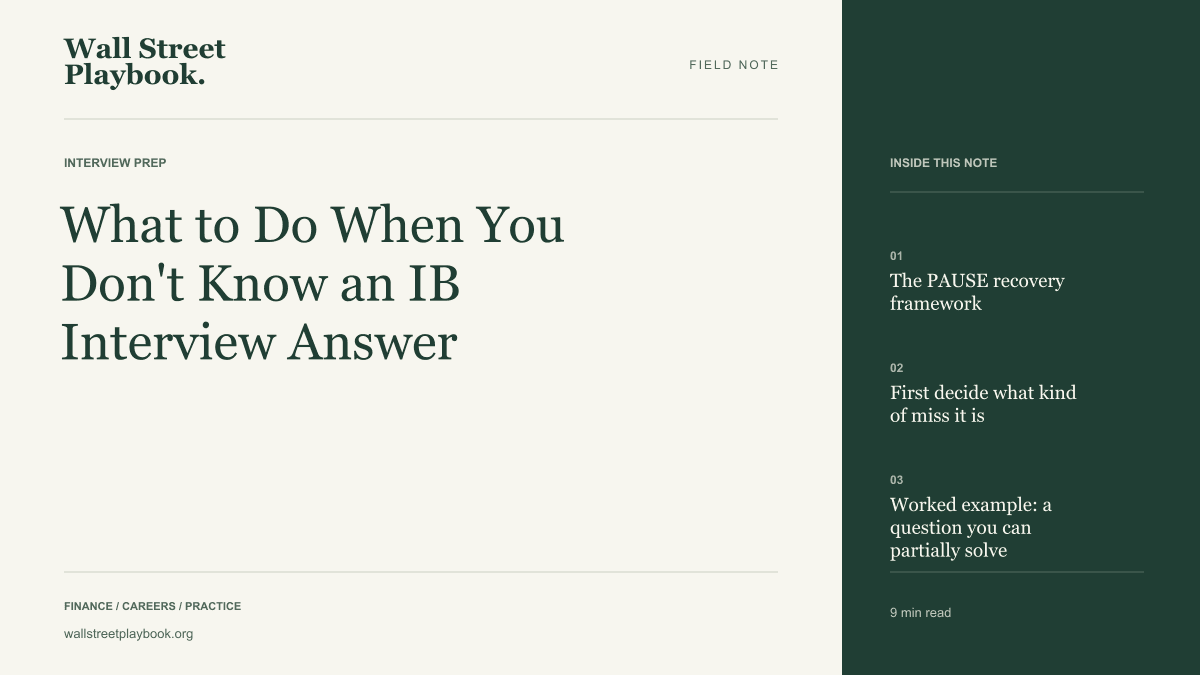
If you do not know an investment banking interview answer, do not bluff and do not stop at “I don't know.” Pause, clarify what is being asked, state the part you know, work from explicit assumptions, and mark the boundary of your certainty.
That will not turn a missing fundamental into a correct answer. It can, however, keep one unfamiliar variation from becoming a rambling guess that damages the rest of the interview.
The PAUSE recovery framework
Use PAUSE when you recognize the underlying topic but cannot immediately produce a complete answer.
| Step | What to do | Useful language |
|---|---|---|
| P — Pause | Take a few seconds. Do not fill the silence with guesses. | “Let me take a moment to structure that.” |
| A — Ask | Confirm the scope, timing, or convention that changes the answer. | “Should I assume a cash transaction and ignore fees?” |
| U — Use what you know | Start with the governing relationship, not a memorized conclusion. | “The starting point is enterprise value to equity value…” |
| S — State assumptions | Name each assumption before using it. | “Assuming no tax effect and no change in debt…” |
| E — End at the boundary | Separate what you can derive from what you cannot verify. | “I can explain the direction, but I would need the share count to calculate the per-share result.” |
The order matters. A clarification asked before reasoning sounds disciplined. A clarification introduced after a confident but unsupported answer sounds like a rescue attempt.
Harvard's career center gives similar advice for case-style questions: repeat the question, clarify it, organize your thoughts, and share how you are solving the problem. It also notes that interviewers often care about the analysis, not just the solution. The Harvard interviewing guide is general rather than banking-specific, so treat it as support for the communication process—not proof of how any particular bank scores candidates.
First decide what kind of miss it is
Do not use the same response for every difficult question.
| Situation | Best response | What not to do |
|---|---|---|
| You understand the concept but need time | Pause, then structure the answer | Start talking before you know your first point |
| The prompt is ambiguous | Ask one narrow clarifying question | Ask the interviewer to restate the entire lesson |
| You know the framework but lack an input | State the framework and identify the missing input | Invent a number or convention |
| You can derive part of the answer | Work aloud and label assumptions | Present a directional answer as exact |
| You do not know the underlying concept | Say so briefly and stop | Hide the gap behind jargon |
If you do not know the concept at all, PAUSE is not permission to perform a long improvised monologue. A clean response is:
“I don't know that concept well enough to give you a reliable answer. I would rather not guess.”
If the interviewer offers a hint, use it. Restate the new information, connect it to something you know, and continue. Do not pretend you knew it before the hint.
Worked example: a question you can partially solve
Interviewer: “A company writes down inventory by $20. Walk me through the three statements.”
Assume you remember that a write-down reduces inventory and creates an expense, but you are unsure whether the interviewer wants a tax effect.
Weak answer
“Net income falls by $20, cash falls by $20, and inventory falls by $20.”
The answer rushes past the tax assumption and incorrectly treats a non-cash write-down as an immediate cash outflow.
PAUSE answer
“Let me structure it by statement. Should I assume a 25% tax rate and that the write-down is tax-deductible?”
“With that assumption, the income statement records a $20 expense, so pre-tax income falls by $20 and net income falls by $15. On the cash flow statement, net income is down $15, but I add back the $20 non-cash write-down, so cash from operations rises by $5 from the tax shield. On the balance sheet, inventory falls by $20, cash rises by $5, and retained earnings falls by $15, so both sides fall by $15.”
This response is useful even before the arithmetic begins: it identifies the convention that controls the tax effect, then lets the interviewer correct the assumption if needed.
If you cannot remember the add-back treatment, stop before asserting the cash-flow result:
“I am confident the write-down reduces pre-tax income and inventory. I am not confident enough about the cash-flow adjustment to state it as fact.”
That is an incomplete answer. It is still better than an internally inconsistent one.
What “thinking out loud” should sound like
Thinking out loud means exposing a short chain of logic. It does not mean narrating every association in your head.
Use this pattern:
- Name the relationship: “Enterprise value equals equity value plus net debt and other senior claims, less non-operating assets.”
- Apply the prompt: “An extra $50 of cash is a non-operating asset, so enterprise value is unchanged while equity value rises by $50, all else equal.”
- Check the boundary: “That assumes the cash is truly excess and the operating outlook is unchanged.”
The University of Pennsylvania's career service recommends taking a moment and asking for clarification when a question is unclear. Its first-interview guidance also says it is acceptable not to know an answer. Again, that is general interview guidance; an interviewer may still view a missing core accounting or valuation concept as a substantive gap.
Three responses that usually make the miss worse
1. The confident guess
“I believe the answer is probably…” is not a substitute for a derivation. If you are estimating, label it as an estimate and show the basis.
2. The unlimited clarification loop
One focused question can define the problem. Five broad questions can make it look as though you want the interviewer to solve it for you.
3. The promise to learn later
“I would research it after the interview” may be honest, but it does not show what you can do now. First establish the part you can reason through. Use the research statement only when you have reached the genuine boundary of your knowledge.
A 20-minute recovery drill
Practice the response, not just the underlying technicals.
- Pick five questions from the investment banking technical question bank.
- Have a partner alter one assumption in each question.
- Give yourself five silent seconds before speaking.
- Ask no more than one clarifying question.
- State each assumption before using it.
- Stop when you reach something you cannot support.
- After the drill, review the missed concept and answer the same variation again from the beginning.
Score each attempt from 0 to 2 on four dimensions:
| Dimension | 0 | 1 | 2 |
|---|---|---|---|
| Scope | Answered a different question | Partly scoped | Confirmed the exact task |
| Logic | Guessed | Some reasoning shown | Clear relationship and steps |
| Assumptions | Hidden | Mentioned late | Stated before use |
| Boundary | Bluffed or froze | Vague uncertainty | Precisely marked what was unknown |
An 8 does not mean the technical answer was correct. It means the recovery process was controlled. Track technical accuracy separately so communication practice does not disguise a knowledge gap.
The limitation to remember
Composure is not a replacement for preparation. Missing an obscure variation is different from missing how the three statements link, the difference between enterprise and equity value, or the basic steps of a DCF. Use the technical learning order to repair the underlying gap, then practice PAUSE under time pressure.
Once the immediate problem is answered, the useful next step is rehearsal: use the Finance Technical Interview Guide for frequency-tagged questions and short-form answer practice.
Work through the next decision
Use the focused exercise that matches the point you need to resolve: