Choose the role by the work you can demonstrate
Start with the actual role description: some teams combine trading, research and production work. The label alone does not tell you whether you will own live risk, research a signal, or maintain a system. Compensation depends on the employer, responsibilities and performance; a job title is not a reliable pay ranking.
For a trading interview, explain a decision under uncertainty, the risk limit, and what changed after feedback. For a research interview, explain the hypothesis, data split, leakage checks, and the result that would make you reject the signal. These are preparation examples, not universal employer requirements.
Use the quant interview playbook sample for both types of practice. When your question is about compensation rather than role fit, keep cash, bonus and contingent awards separate using the finance pay comparison.
"Quant" is one of the most overused words in finance recruiting. A quant trader and a quant researcher can sit on the same floor, work on the same strategy, and have almost entirely different jobs. Understanding the distinction matters if you're choosing between the two paths, or trying to break into either.
The short answer: quant traders focus more on live decisions, execution, risk, and market feedback; quant researchers focus more on finding signals, testing hypotheses, and building models. Neither role automatically pays more. At top firms, entry-level base salaries can be identical, while bonuses and senior upside depend more on firm, performance, and P&L ownership than the job title.
If you are using this comparison to choose a recruiting path, make the decision practical: pick the role where you can prove the hiring signal fastest. A strong quant trader resume usually shows speed, market intuition, game theory, probability, and live decision-making. A strong quant researcher resume shows statistical rigor, original research, data discipline, and coding depth.
Applying to quant roles? Your resume has to make the trader-vs-researcher fit obvious in seconds. Use the Quant Trading Resume Review for positioning, then inspect the Quantitative Finance Interview Playbook sample for probability, trading decisions, research evaluation and Python practice.
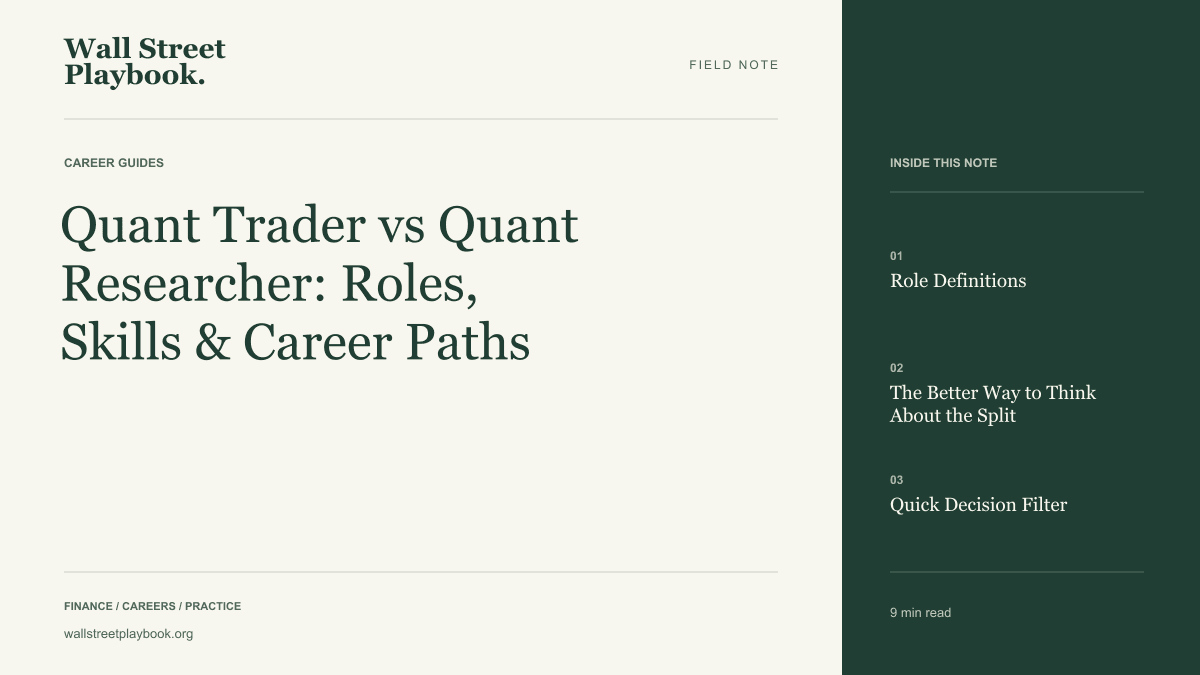
Role Definitions
Quant Trader (QT): Works closest to live trading decisions: pricing, execution, inventory, position management, and risk. The amount of model development and direct P&L ownership varies by firm and seniority.
Quant Researcher (QR): Develops and tests models, signals, datasets, and trading systems. At some firms researchers also write production code and help run strategies; at others the role is more specialized.
The analogy: researchers build the engine, traders drive the car. In practice, the line blurs, especially at smaller firms, but the core distinction holds.
The Better Way to Think About the Split
The trader-versus-researcher question is really about feedback loops.
| Role | Feedback Loop | What You Are Paid For |
|---|---|---|
| Quant Trader | Seconds, minutes, days | Turning uncertainty into live decisions without losing discipline |
| Quant Researcher | Weeks, months, years | Finding real signals, rejecting false ones, and building repeatable research infrastructure |
That difference affects everything: interview style, resume bullets, project choice, compensation variance, and the type of stress you will feel.
If you hate being wrong in public, trading may feel brutal. If you hate spending weeks proving that an idea does not work, research may feel slow. Neither path is easier. The pain is just different.
Quick Decision Filter
| Question | If Yes | Lean |
|---|---|---|
| Do you enjoy making fast decisions with incomplete information? | You like live risk, games, and market-making interviews | Quant Trader |
| Do you prefer proving whether an effect is real before acting on it? | You like research, statistics, and data quality problems | Quant Researcher |
| Do you have contest math, poker, trading games, or personal trading proof? | That proof is easier to explain to trading desks | Quant Trader |
| Do you have a thesis, papers, Kaggle work, ML projects, or deep stats work? | That proof is easier to explain to research teams | Quant Researcher |
| Do you want direct P&L upside and can tolerate volatile outcomes? | More compensation variance can be acceptable | Quant Trader |
| Do you want a deeper research track with more stable feedback loops? | Research output compounds over longer cycles | Quant Researcher |
Day-to-Day Comparison
| Dimension | Quant Trader | Quant Researcher |
|---|---|---|
| Morning routine | Review overnight fills, check positions, assess market conditions | Review research pipeline, check backtest results, read new papers |
| Core work | Execution optimization, risk management, real-time adjustments | Signal development, feature engineering, statistical testing |
| Market hours | Actively managing positions and flow | Research work (largely market-hour independent) |
| After close | P&L attribution, position review, next-day prep | Longer-horizon research, model iteration |
| Meetings | Risk reviews, market color, trader meetings | Research presentations, strategy reviews |
| Crisis behavior | First responder, managing drawdowns in real time | Analyzing what went wrong, adjusting models |
Why a “Typical Week” Can Mislead You
A market-making trader, an options trader, and a systematic portfolio trader do not share one schedule. The same is true for a researcher working on short-horizon signals, machine-learning infrastructure, or longer-horizon portfolio construction. Use the comparison table as a map of responsibilities, then ask the team how work is split between live risk, research, coding, and production support.
Jane Street's current role descriptions are a useful example of overlap: its traders identify signals, build models, and manage risk, while its researchers build models, strategies, systems, and production code alongside traders and engineers. The title does not create a clean wall between “driving” and “building.”
Technical Skills
| Skill | Quant Trader | Quant Researcher |
|---|---|---|
| Programming (Python/C++) | Strong (execution systems, tools) | Very strong (research infrastructure) |
| Statistics/Econometrics | Working knowledge | Expert-level |
| Machine Learning | Applied understanding | Deep expertise (often PhD-level) |
| Market Microstructure | Expert-level | Working knowledge |
| Risk Management | Expert-level | Moderate |
| Real-time Systems | Critical | Less important |
| Data Engineering | Moderate | Important (data pipelines, cleaning) |
| Academic Research | Helpful | Essential (reading and producing) |
Educational Backgrounds
Quant Traders typically come from:
- Math, physics, or engineering undergrad + trading competitions
- CS or math PhD (less common than for QR)
- Prop trading internships or market-making experience
- Some transition from sell-side electronic trading
Quant Researchers often come from:
- Undergraduate, master's, or PhD programs in statistics, math, physics, CS, or electrical engineering
- Postdoctoral research in ML/AI or statistical modeling
- Academic backgrounds with strong publication records
- Some from data science roles at tech companies
A PhD can be valuable for research-heavy specialties, but it is not a universal gate. Jane Street's current quantitative-researcher posting calls a PhD or other research experience a plus, not a requirement, and the firm says it has no general degree requirement. Read the actual posting instead of assuming every QR seat follows the same credential model.
Get quant finance recruiting notes
Quant trading and research applications, probability practice and project evidence.
No spam. Unsubscribe anytime.
What "Strong" Looks Like in Practice
| Candidate Signal | Reads Like QT | Reads Like QR |
|---|---|---|
| Coding project | Built a market-making simulator with inventory limits, adverse selection, and P&L attribution | Built a reproducible signal research pipeline with train/test separation and transaction cost assumptions |
| Competition | Performed well in trading games, poker, math contests, or market-making competitions | Published research, won ML/statistics competitions, or built serious open-source research tools |
| Interview answer | Makes a fast decision, explains sizing, and adjusts when assumptions change | Slows down, states assumptions, tests whether the effect is real, and avoids overfitting |
| Resume bullet | Shows decisions under uncertainty and measurable trading/risk outcomes | Shows statistical rigor, model validation, feature work, and research output |
Neither profile is "better." The problem is when your resume says QR but your interview answers sound QT, or the reverse. Firms can forgive a nontraditional background faster than they forgive a confused signal.
Interview Signals: What Firms Are Really Testing
Quant interviews are not just math contests. They are trying to see whether your instincts match the job.
Quant Trader Interview Signals
You will usually get tested on:
- Mental math under time pressure
- Probability and expected value
- Market-making games
- Betting, sizing, and updating beliefs after new information
- Risk limits and when to stop trading
- Communication under pressure
The best candidates are not the ones who instantly know every answer. They are the ones who stay calm, state assumptions, make a reasonable decision, and adjust when the interviewer changes the game.
Quant Researcher Interview Signals
You will usually get tested on:
- Statistics, inference, and experimental design
- Machine learning, optimization, and feature selection
- Time-series pitfalls and non-stationarity
- Backtesting discipline, transaction costs, and overfitting
- Coding depth in Python, C++, or research tooling
- Ability to explain a research project without hand-waving
The best candidates are skeptical. They do not fall in love with a signal just because the backtest looks good. They ask whether the effect survives costs, regime shifts, data leakage, and out-of-sample testing.
Compensation
Compensation varies significantly by firm, location, experience, and how directly the role affects a strategy. Public job postings are reliable for advertised base salary, but they usually do not disclose the annual bonus and cannot support a precise total-compensation table.
As of July 2026, Jane Street's New York postings list a $300,000 base salary for both quantitative trader and quantitative researcher roles, with an annual discretionary bonus on top. That is a useful top-firm datapoint, not the market median. A bank quant role, a new-grad market-making role, and an experienced hedge-fund researcher should not be collapsed into one range.
When comparing offers, separate:
| Component | Question to ask |
|---|---|
| Base | Is this the guaranteed annual salary for this location and level? |
| Sign-on | Is it one-time cash, guaranteed bonus, or subject to clawback? |
| Annual bonus | Discretionary, formulaic, or explicitly tied to desk/firm performance? |
| Deferred pay | How much vests later, and what happens if you leave? |
| P&L economics | Does the role receive a defined share, or is that only a senior-PM structure? |
Which Pays More?
At entry level, the answer is: top-firm quant trader and quant researcher offers can both be enormous, and the firm matters more than the title.
At senior levels, PM-style roles can have higher upside when compensation is explicitly tied to P&L. That is a statement about incentive structure, not proof that every trader out-earns every researcher. Senior researchers who own important signals or systems may also have highly variable pay.
The catch is survivorship bias. The trader upside you hear about usually belongs to people who survived, scaled risk, and kept producing. The median path is less glamorous than the top-decile headline.
Firm-Level Differences
| Firm Type | QT Comp Premium | QR Comp Premium | Notes |
|---|---|---|---|
| Top HFT (Citadel Securities, Jane Street) | Very high | High | Trading-focused, pay scales with performance |
| Multi-Manager (Millennium, Citadel) | Very high | High | Pod structure, direct P&L attribution |
| Quant Hedge Fund (DE Shaw, Two Sigma) | High | Very high | Research-heavy, QRs are highly valued |
| Bank Quant Desk | Moderate | Moderate | More stable, lower ceiling |
Career Trajectory
Quant Trader Path
- Junior Trader (0-2 years): Learning execution, managing small positions, assisting senior traders
- Trader (2-5 years): Running strategies independently, managing meaningful risk
- Senior Trader / PM (5-10 years): Overseeing multiple strategies, larger capital allocation
- Head of Desk / Partner (10+ years): P&L responsibility for an entire desk or group
Common exits: Launch own fund, portfolio manager at multi-manager, senior trading role at a different firm, fintech venture.
Quant Researcher Path
- Junior Researcher (0-2 years): Working on assigned research projects, extending existing models
- Researcher (2-5 years): Independent research agenda, developing production signals
- Senior Researcher / Research Lead (5-10 years): Leading research teams, architecting strategy frameworks
- Head of Research / Partner (10+ years): Setting research direction for the firm
Common exits: CTO/CIO at smaller fund, AI/ML leadership at tech companies, academic positions, launch own systematic fund.
Recommended Resource
Quantitative Finance Interview Playbook
Application evidence, probability, trading decisions, research evaluation and Python practice. Inspect the sample to check the level.
How to Choose Between the Two
| If You... | Consider |
|---|---|
| Thrive under real-time pressure | Quant Trading |
| Prefer deep, uninterrupted research blocks | Quant Research |
| Want direct P&L ownership and accountability | Quant Trading |
| Want to publish or stay connected to academia | Quant Research |
| Have deep research experience in a quantitative field | Quant Research (natural fit) |
| Won math competitions or traded personal accounts | Quant Trading (natural fit) |
| Want higher bonus upside with more volatility | Quant Trading |
| Prefer longer research cycles over intraday decisions | Quant Research |
| Care about work-life balance | Ask the specific team; title alone does not answer this |
Choose the Role You Can Prove, Not the One That Sounds Better
Most candidates make this decision backwards. They ask, "Which one pays more?" or "Which one is more prestigious?" The better question is: which one can I credibly prove in the next 90 days?
If you want quant trading, build proof that resembles live decision-making:
- Market-making simulator with inventory and adverse-selection logic
- Poker, betting, or trading-game track record
- Options, futures, or crypto project with risk limits and P&L attribution
- Fast mental math and probability prep that holds up under pressure
If you want quant research, build proof that resembles research discipline:
- Signal project with train/test separation and transaction costs
- Reproducible notebook or package with clean data pipeline
- Statistical test that rejects a weak idea instead of cherry-picking a result
- Research write-up that explains assumptions, robustness checks, and failure modes
The fastest way to look average is to write "passionate about markets and machine learning" and then show no evidence of either.
The Hybrid Reality
At many firms, especially smaller ones, the line between QT and QR is porous. Researchers may trade their own signals. Traders may develop proprietary models. Some firms hire "quant trader-researchers" who do both.
If you're genuinely strong at both, these hybrid roles offer the best of both worlds: intellectual depth plus direct market exposure.
The keyword is genuinely. A hybrid candidate needs proof on both sides: not just "I like markets and machine learning," but a project where the research connects to a tradable rule, and the tradable rule survives basic cost, risk, and robustness checks.
Breaking In
For Quant Trading:
- Compete in trading competitions (Jane Street ETC, Citadel Datathon)
- Build a live trading track record (even small scale)
- Demonstrate speed and composure in interviews (expect mental math, probability, and market-making games)
For Quant Research:
- Build a research portfolio (Kaggle competitions, published papers, open-source projects)
- Master Python, R, or C++ for quantitative analysis
- Demonstrate statistical rigor, firms will test your ability to avoid p-hacking and overfitting
What Your Resume Should Emphasize
| Target | Lead With | Cut or Minimize |
|---|---|---|
| Quant Trader | Mental math, probability, trading games, market-making, risk-taking, fast coding tools | Generic coursework without proof of decision-making |
| Quant Researcher | Research papers, statistical tests, ML methods, data cleaning, backtests, reproducible code | Surface-level trading interest without research depth |
| Quant Developer | C++, systems, latency, distributed data, execution infrastructure, reliability | Finance buzzwords that do not show engineering depth |
| Hybrid QT/QR | Live trading projects plus signal research and validation | Anything that makes you look unfocused rather than cross-functional |
The mistake is trying to look like every quant candidate at once. The strongest resumes choose a lane and make the evidence obvious.
Two Better Resume Openings
Quant trader-leaning: "Math and CS candidate with market-making competition experience, probability-heavy interview prep, and a live options-tracking project focused on volatility, hedging, and P&L attribution."
Quant researcher-leaning: "Applied math researcher with Python/C++ research infrastructure, time-series modeling experience, and a signal validation project built with out-of-sample testing, transaction costs, and feature decay analysis."
Those are not final resume summaries. They show the difference in signal. One says live decision-making. The other says research rigor.
Build the Quant Recruiting Stack
If this page helped you choose a direction, turn that decision into a recruiting asset:
- Resume positioning: Quant Trading Resume Review
- Interview preparation: Quantitative Finance Interview Playbook, with application evidence, probability, trading and research cases, Python examples and two mock rounds. Read the actual sample before deciding whether the paid guide fits your level.
- Pay benchmark: Finance Salaries in 2026
- Open roles: Sales and Trading Jobs
Sources checked July 13, 2026: Jane Street quantitative trader posting, Jane Street quantitative researcher posting, Jane Street's quantitative research overview, and Jane Street's interview and education FAQ.
Related Reading
- Sales & Trading Interview Questions: What to Expect in 2026, Prep for discretionary trading desks
- Private Equity Compensation 2026, Compare quant comp to the buy-side alternative
- How Finance Jobs Are Actually Filled in 2026, The mechanics of getting hired
Work through the next decision
Use the focused exercise that matches the point you need to resolve: